Christmas Lights Installation UAE: Make Your Home Shine This Christmas
What do you see when you look at a piece of fabric?
You may see colour, texture, or design.
However, there is a much bigger story behind it.
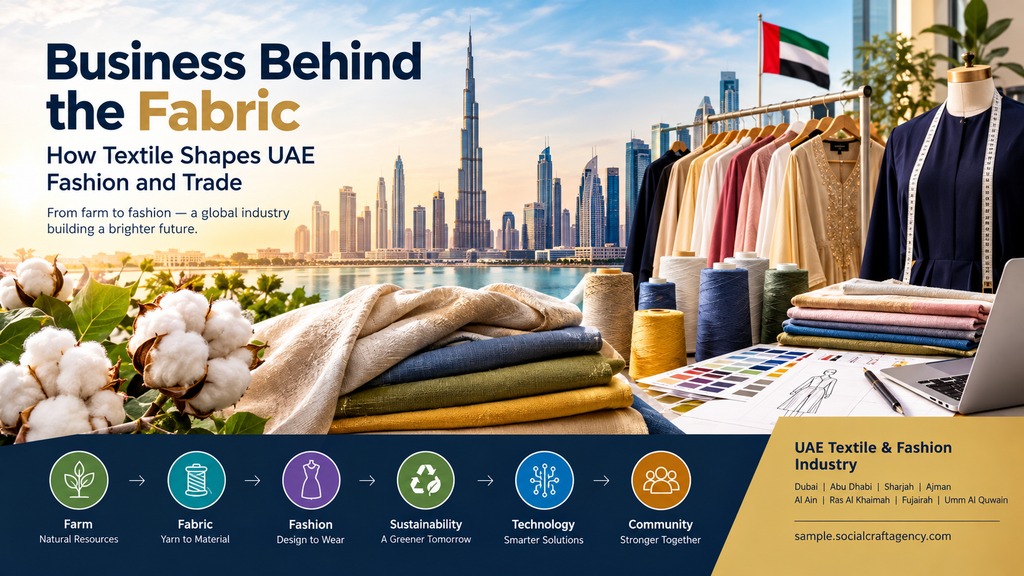
It can begin with a farm, cotton crop, fibre, yarn, or chemical process. Then, it moves through spinning, weaving, knitting, dyeing, finishing, trading, designing, and retail.
That entire journey creates the business behind the fabric.
In the UAE, this story connects local buyers with global textile markets. Dubai, Sharjah, Abu Dhabi, and other cities play different roles in this growing ecosystem.
Therefore, understanding fabric means understanding much more than fashion.
It means understanding business.
What Does “Business Behind the Fabric” Mean?
The business behind the fabric describes everything that happens before a finished garment reaches a customer.
It includes:
- Agriculture
- Cotton and fibre production
- Yarn manufacturing
- Textile mills
- Fabric production
- Dyeing and finishing
- Textile trading
- Import and export
- Fashion design
- Garment manufacturing
- Wholesale
- Retail
- Technology
- Sustainability
- Logistics
Each stage adds value.
At the same time, each stage carries its own costs, risks, skills, and opportunities.
That is why a simple shirt can represent a surprisingly complex global supply chain.
The Fabric Business Starts Before Fashion
Fashion often begins long before a designer sketches a collection.
The story can start with raw materials.
Cotton farmers grow the crop. Fibre processors prepare the material. Spinners turn fibre into yarn. Mills then transform yarn into fabric.
After that, dyeing and finishing can change the fabric’s colour, feel, weight, and performance.
Finally, designers and manufacturers turn the fabric into products.
This creates a chain of businesses behind every finished garment.
From Farm to Fabric
The farm is an important starting point for many natural textile products.
Cotton, for example, connects agriculture with manufacturing.
Weather can affect supply.
Water availability can affect production.
Input costs can affect farmers.
Global demand can affect prices.
Therefore, changes at the farm level can eventually reach textile manufacturers and fashion businesses.
This is why Farm belongs beside Fabric and Fashion when discussing the textile economy.
The Role of Textile Mills
Textile mills transform raw materials into usable textile products.
Depending on the business, a mill may specialise in spinning, weaving, knitting, dyeing, finishing, or several stages.
Technology plays an increasingly important role here.
Modern machinery can improve consistency, production speed, quality control, and resource efficiency.
However, machinery alone does not create a successful textile business.
Skilled people still matter.
Experience matters.
Quality management matters.
And market knowledge matters.
UAE Textile Business: Where Trade Meets Fashion
The UAE has developed a major position within regional textile trade.
Dubai, in particular, connects suppliers, wholesalers, retailers, designers, manufacturers, and international buyers.
TEXMAS describes Dubai’s textile trade as a regional hub connecting Asian mills with markets across Africa, Europe, the Gulf, and beyond. Its Dubai Textile City also provides dedicated trading and warehousing infrastructure.
That creates an important opportunity for businesses working with fabric.
A company does not necessarily need to manufacture every product locally.
Instead, it can source materials internationally and use the UAE as a trading, distribution, design, or retail base.
Business Behind the Fabric in Dubai
Dubai has a diverse textile ecosystem.
It includes wholesalers, retailers, fashion businesses, importers, exporters, designers, tailors, and manufacturers.
Areas such as Bur Dubai and the traditional textile trading districts remain important to the city’s fabric culture.
The city’s location also helps businesses connect with suppliers and customers across multiple regions.
As a result, textile business in Dubai can involve much more than selling fabric.
It can include sourcing, distribution, re-export, fashion production, uniforms, home textiles, and luxury materials.
Fabric Business in Abu Dhabi
Abu Dhabi also forms part of the UAE’s wider textile and apparel ecosystem.
Businesses can serve local consumers, institutions, fashion brands, hospitality companies, and other commercial buyers.
For textile entrepreneurs, the opportunity depends on the chosen niche.
A fabric wholesaler has different needs from a fashion label.
Likewise, a uniform supplier has different requirements from a luxury designer.
Understanding the customer comes first.
Textile Business in Sharjah
Sharjah has a strong connection with manufacturing, trade, crafts, and industrial activity.
Its proximity to Dubai also creates useful connections between textile suppliers and customers.
For fabric businesses, Sharjah can support wholesale, manufacturing, sourcing, and distribution models.
The city’s industrial environment can also appeal to businesses that need more operational space.
Textile Business in Ajman
Ajman has become another location of interest for businesses seeking commercial and industrial opportunities.
Textile companies can explore wholesale, manufacturing, garment production, and related supply activities.
However, the right location depends on the company’s licence, customers, logistics, workforce, and operating model.
Textile Business in Al Ain
Al Ain has a different commercial profile from Dubai and Sharjah.
Therefore, textile businesses targeting this market should focus on local customer demand.
Tailoring, uniforms, traditional clothing, fashion, and home textile products can serve different customer groups.
The key is understanding what the local market actually needs.
Textile Business in Ras Al Khaimah
Ras Al Khaimah offers another business environment within the UAE.
Manufacturing and industrial businesses can explore opportunities beyond the major commercial centres.
For textile companies, location should depend on production requirements, transport, customers, and supply-chain access.
Textile Business in Fujairah
Fujairah has a strategic position on the UAE’s eastern coast.
For businesses involved in logistics and trade, location can become an important consideration.
A textile company should assess shipping routes, storage, customer locations, and supplier access before selecting an operating base.
Textile Business in Umm Al Quwain
Umm Al Quwain can also interest businesses looking for a smaller commercial environment.
For textile entrepreneurs, the decision should come down to the business model.
Wholesale, retail, manufacturing, and online textile businesses can have very different requirements.
How the Fabric Supply Chain Works
The textile supply chain has many moving parts.
A simplified journey looks like this:
H3: 1. Raw Materials
Businesses source cotton, wool, linen, silk, synthetic fibres, recycled fibres, or other materials.
H3: 2. Yarn Production
Fibres can become yarn through spinning or other manufacturing processes.
H3: 3. Fabric Manufacturing
Mills weave or knit yarn into fabric.
H3: 4. Dyeing and Finishing
The fabric can then receive colour, texture, softness, strength, water resistance, or other finishes.
H3: 5. Fabric Trading
Wholesalers and distributors move fabric into different markets.
H3: 6. Fashion and Garment Production
Designers and manufacturers transform fabric into clothing and other products.
H3: 7. Retail and Consumers
Finally, finished products reach stores, websites, boutiques, and customers.
Every step creates a business opportunity.